Detailed Companion to the B2 Long-Distance Buyer Guide
Long-Distance Mover Verification Guide
Before you trust a company with everything in your home, get the price, delivery commitment, shipment method, crew model, protection, communication ownership, and carrier authority in writing.

Long-distance moving is not just a larger local move. The pricing method, delivery model, shipment handling, crew structure, protection, communication ownership, and carrier authority can differ dramatically. This guide is designed to help you secure the clearest protections and best service fit—whether you book with B2 or another qualified mover.
1. Determine Whether You Are Hiring a Carrier or a Broker
A moving carrier operates moving equipment and performs the transportation. A moving broker arranges transportation with another company. A broker may market the move, collect information, and take a deposit, but another carrier may be assigned to perform the job.
The issue is not the label alone—it is whether the role is disclosed and whether you understand who is accountable. Ask these questions before paying a deposit:
- What is the exact legal name of the company I am hiring?
- Are you the carrier that will transport my shipment or a broker arranging another carrier?
- Whose USDOT number and legal name will appear on the bill of lading?
- Whose truck and employees will arrive at pickup and delivery?
- Will the shipment transfer between trucks, warehouses, or companies?
If the salesperson cannot answer plainly, pause the booking process. The written estimate and move documents should identify the same company and operating model that were explained to you.
2. Verify the Mover’s Federal Record
Interstate movers are regulated at the federal level. Ask for the mover’s legal name and USDOT number, then use the FMCSA SAFER Company Snapshot to check the public carrier record. You can also use FMCSA’s consumer resources at Protect Your Move.
Compare the record with what you were told
- Does the legal name match the estimate, payment request, and website?
- Do the address and phone information make sense?
- Is the entity identified as a carrier, broker, or both?
- Does the record show household goods among the cargo carried?
- Does the company have the authority appropriate to the service it is offering?
A USDOT number displayed on a website is only a starting point. Look it up and confirm that it belongs to the business asking you to sign and pay.
3. Verify the Estimate and Pricing Method
The lowest estimate is not necessarily the lowest final cost. First determine whether the price is binding or non-binding and whether it is based on weight, cube-volume, truck space, or another variable. Then compare the inventory, access, packing, delivery, protection, exclusions, and price-change terms.
A useful written long-distance quote should explain:
- The mover’s legal identity, addresses, dates, and contact information
- The inventory, estimated volume or weight, and method used to assess the move
- Stairs, elevators, parking distance, shuttle needs, and access at both locations
- Packing, unpacking, disassembly, reassembly, storage, and specialty-item services
- The price basis; whether the quote is binding, non-binding, weight-based, or variable; and the payment, deposit, and cancellation terms
- The planned pickup and delivery dates or delivery window
- The selected valuation option, limits, deductibles, exclusions, and claim process
- Every circumstance that can change the price, when you are notified, whether your approval is required, and how the change is documented
Walk room by room before accepting the estimate. Attics, garages, sheds, closets, patios, wall art, and items going into storage are easy to overlook. Send corrections in writing so the mover can revise the scope before dispatch.
4. Know Who Owns Estimate Accuracy
Terms such as “flat rate,” “binding,” or “guaranteed” should never replace a careful reading of the agreement. Ask what the price assumes, exactly what can change it, when you will be notified, and whether you must approve a revised scope and price before work continues.
Added inventory, inaccurate volume, different access, extra packing, a customer-requested delay, storage, or another agreed scope change may affect the price. A reputable process makes those triggers clear and involves you before proceeding instead of introducing unexplained charges at delivery.
If the quote is based on weight
Weight-based pricing is not automatically improper, but the customer should be able to verify the number used to calculate the bill. Ask for certified empty and loaded weight tickets, scale name and location, weighing dates, truck identification, the written rate formula, observation rights, and reweigh rights. Also ask how fuel levels, people or equipment on the scale, scale fees, and travel to a weigh station are handled. An official ticket documents a reading; it does not, by itself, establish that the weighing process and original estimate were accurate.
Ask directly: If the estimate materially misses the shipment, who owns that estimating error and how is the customer protected from lowballing or weight bumping?

5. Verify the Delivery Window and Shipment Method
Delivery timing often depends on the mover’s service model. Some shipments travel directly. Others share truck space, follow a multi-stop route, enter storage, transfer between equipment, or use a destination agent. Those logistics may control the timeline without giving the customer meaningful input. You should know which model applies before you sign.
- Is this a direct point-to-point move or part of a multi-customer route?
- Will the shipment enter a warehouse or transfer to another truck?
- Is delivery stated as a specific date and hour or a broad window?
- Does date-specific or expedited delivery cost extra?
- Who provides updates, and how quickly will that person respond?
- What events can affect timing, who decides the change, and what accountability applies if the commitment is missed?
Require the delivery commitment, possible fees, update process, escalation contact, and responsibility for a missed timeline in writing. Ask whether an exact date and time are included or cost extra, and whether multi-customer logistics can change the window without your input.
Understand co-mingling before agreeing to it
Co-mingling means belongings from multiple customers share a trailer or route. This may involve labels, partitions, cross-docking, warehouses, transfers, or destination agents. Each additional handoff can increase the risk of inventory, timing, or delivery mix-ups.
Ask whether your household goods will be combined with another customer's shipment, how each inventory is physically separated and verified, whether your shipment may transfer between trucks, and who is accountable if an item is missing or delivered to the wrong home.


6. Verify Protection and Claim Ownership
Moving value protection is not the same thing as ordinary property insurance. Ask the mover to explain the available options, limits, deductibles, exclusions, and claim procedure in writing. If you own jewelry, art, antiques, collections, unusually valuable electronics, or other high-value items, ask how they must be declared and whether a customized item-specific protection plan is available.
Photograph important items and their condition, retain receipts or appraisals when applicable, and keep irreplaceable documents, medications, keys, financial records, and small valuables with you rather than placing them on the moving truck.
Verify who owns a claim before you need one
Many claim nightmares begin when responsibility is divided among sales, dispatch, the transporting carrier, a destination agent, and a third-party claims administrator. Before booking, ask who personally owns the claim, who documents it on site, the inspection and response deadlines, the escalation path, the expected resolution timeline, and whether your original customer contact remains involved through closure.
7. Verify the Crew Types at Both Ends
Long-distance service depends on the crew as much as the paperwork. Ask whether employees, contractors, day laborers, or destination agents will prep and load your belongings at origin and carry them into the new home at destination. Crew continuity preserves knowledge of fragile items, assemblies, special instructions, and placement priorities.
If third parties are used, ask who employs, trains, screens, supervises, and insures them; how their experience is verified; and whose management responds to damage, injury, or a service failure.
Companies that publish real team information make it easier to understand their culture and operating model. B2 customers can meet our drivers and movers as well as the office teammates who support their work.

8. Identify Service-Level Ownership
High-touch service should mean more than a friendly salesperson before the deposit. Ask who owns your plan from booking through delivery and what authority and resources that person has when something unexpected happens.
- Who do I call if the inventory or truck-space estimate is wrong?
- Can that person reach operations and authorize a correction?
- What happens if all expected inventory will not fit or items remain after loading?
- Who coordinates status updates, scope changes, delivery issues, and claims?
- What escalation path applies if a promised service level is missed?
A company should explain who owns communications, who has authority to make decisions, and how it will mobilize people, equipment, and operations support when the plan needs correction. The time to learn that answer is before move day.
Long-Distance Mover Verification Checklist
Use this short list with every company you are considering. Save screenshots or copies of the public record and the documents you receive.
- Record the legal company name, DBA, USDOT number, MC number, physical address, and phone number
- Verify whether the company is the transporting carrier, a broker, or both
- Check active DOT authority and the FMCSA safety record; compare the legal carrier with the estimate, payment recipient, and Bill of Lading
- Confirm whose truck, driver, and crew will handle pickup, transportation, and delivery—and why a rental truck will be used, if applicable
- Reconcile the inventory, access, packing, specialty services, dates, and delivery plan
- Determine whether pricing is binding flat-rate, non-binding, weight-based, or variable; for weight pricing, request certified tickets and reweigh rights
- Ask whether the shipment will be co-mingled, cross-docked, warehoused, or transferred and how inventory separation is verified
- Identify the person accountable for unexpected scope, space, delivery, communication, and claim issues
- Read the scope-change terms, payment schedule, cancellation policy, value-protection terms, and claim process
- Keep the estimate, order for service, bill of lading, inventory, receipts, emails, and condition photos together
The B2 Long-Distance Standard
B2 Moving brings planning, packing, protection, transportation, and delivery under one accountable Northwest Arkansas company. You can meet our team, verify our authority, review our pricing, and understand your protection before we ever enter your home.
Guaranteed Pricing—Cube-Volume Based Estimates
- Binding flat-rate contract for the agreed written scope
- Full price transparency—no hidden fees or surprises
- Flexible, documented scope revisions if your plans change
Pinpoint Delivery
- Exact scheduled delivery date and time at no extra cost
- Your shipment is planned around your schedule
- Flexible, communicated changes when you need them
Zero Shared Shipments
- No co-mingling with another customer’s inventory
- One household shipment using only its assigned B2 truck or trucks
- Direct-to-destination move plan without warehouse transfers or cross-docking
B2-Trained Crew Members Only
- The same familiar crew members serve both ends
- No third-party crews, contractors, destination agents, or day laborers
- Meet the B2 movers and drivers
Full Value Protection Included
- Up to $50,000 per truck / $6 per pound of shipment weight
- $0 deductible and itemized protection on the contract
- Custom B2 protection plans available for qualifying high-value items
- Urgent, team-owned claim handling with the customer’s CSR remaining involved
High-Touch Service
- One-stop ownership and communications through your assigned CSR
- Backed by all B2 operations, crew, equipment, and claims resources
- Proactive updates from booking through delivery
Active DOT Authority
- B2 Delivery LLC dba B2 Moving—USDOT 3219041 / MC 1006995
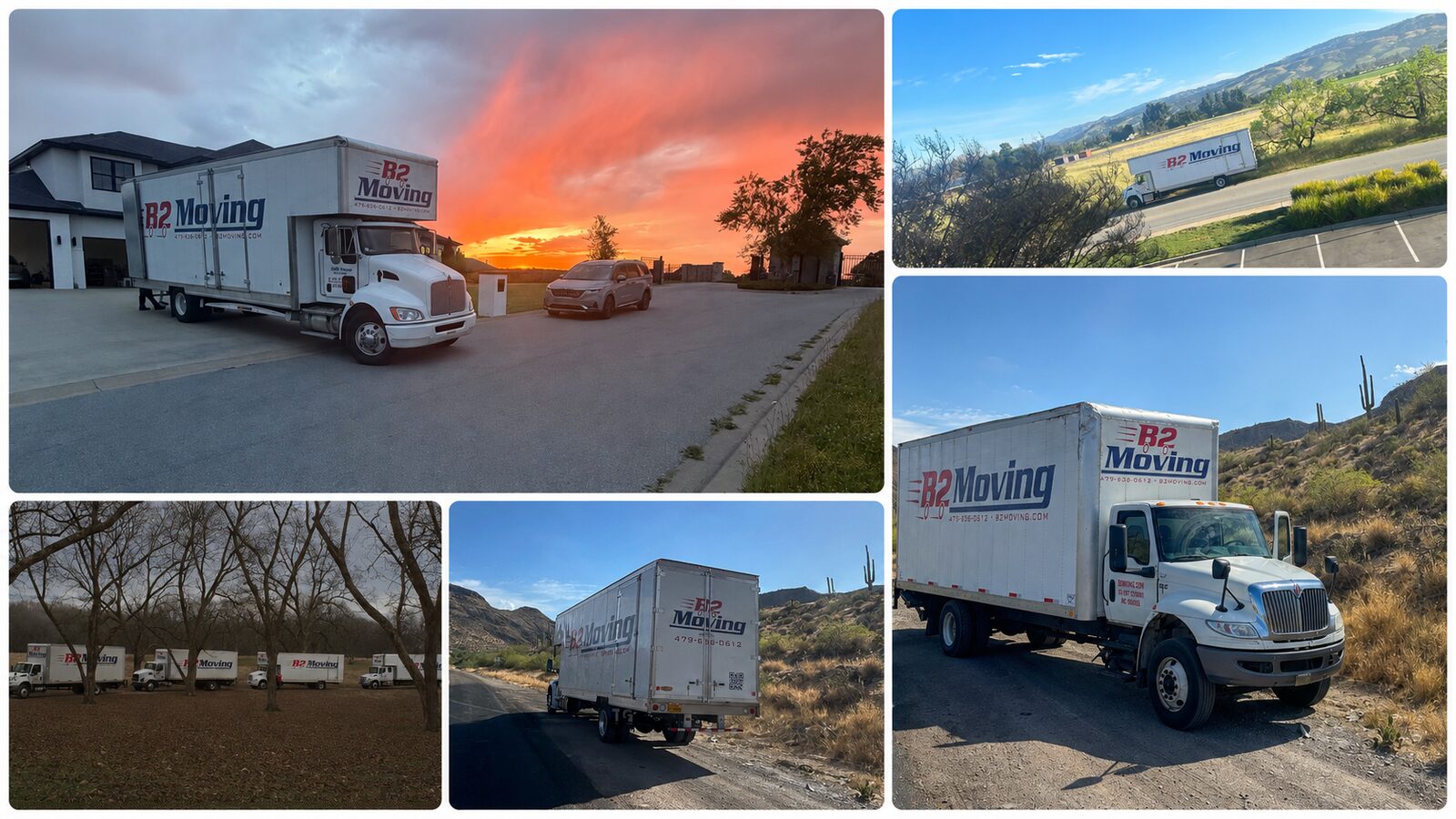
- B2-owned and operated trucks with trained in-house crews
- Direct accountability—no broker handoff
Customers can verify B2’s current FMCSA SAFER record and review route examples, included services, and our quote process on the B2 long-distance moving service page. Written contracts, protection selections, exclusions, and terms govern each move.